


Introduction: A Global Trade Earthquake
Tariffs as a form of power projection have not only become vital strategies to pursue in the high-stakes game of geopolitics and economics but are also tools to exploit by competing nations and entities. Former U.S. President Donald Trump, with his America First policy, is once again using the book of protectionism by imposing new tariffs on both allies and enemies in 2025. With the globe at a precarious economic juncture, the move has shaken both the diplomatic circles and exchange centres.
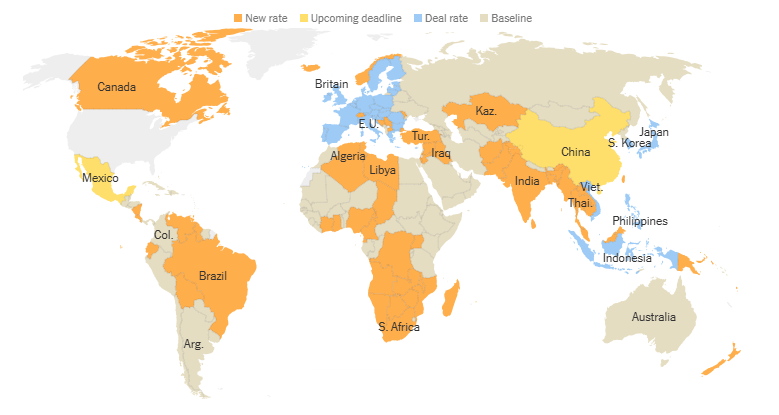
The tariffs set by Trump are not restricted to one country or one sector. This is not just a two-player game between the U.S. and China. It is a politicking resetting of the global trade positions where we find a screechy message that economic alignment with the American interest is now not up to negotiable options. The ramifications run wide also as they reach into the sphere of livelihoods and factories towns, trade corridors and the power equation. And mechanically, to what countries is it beaten the most?
We will now consider the ten countries that are most affected by the Trump policy of imposing tariffs in 2025 not only in economic terms but also in terms of national moods, betrayed trust, and new shifts in strategy.
1. China: The Relentless Pressure Point
There is no state that is burdened by the U.S tariffs than China. Chinese products have been the most targeted since the first round of tariffs in 2018. As the steps towards 2025 reinstate 20-25 percent duties on such factors as semiconductors, steel, and electronics, Beijing has to adjust its economic drivers once again.

However, there is something more at the stake besides the spreadsheets. This is the repeated targeting of the Chinese industries that has been internalized in China as part of a larger policy to contain them. There is fear among commentators in state media of an economic siege, and Chinese firms are fast tracking self-reliance. A much-hyped phase of rigorous U.S.-Chinese economic entangling has become a situation of apprehensiveness.
As a result, China is investing more in its ideology of (twin circulation) where they invest more on home demand and open up the international markets with extreme caution. The supply chains are being moved to regionalized sources, and the American reliances on technology are quickly being phased down as well.
2. Mexico: From Trusted Partner to Trade Casualty
Mexico is a unique scenario as the economy of Mexico is so closely tied to that of the U.S. Although Mexican autoparts, avocado, and steel industries fall under the updated USMCA agreement, the industries are currently experiencing a new tariff war.
The environment of the north is the treason of the factory towns in frontier. Entrepreneurs remember having to change their operations to accommodate the USMCA demands and now are left at the edge of the table. The statement in it is too declarative: We did our part, and we who were the victims, are.
The spill over effects of the economy are solemn Mexican supply chains supporting U.S. car manufactures are increasing their expenses and the export revenues of Mexico are predicted to decline on a billions level. Conceptually, as a side effect, Mexico is taking a tentative step in diversification outside the U.S. by seeking South American and European contacts in order to hedge against its exposure.
3. India: An Ally Singled Out
The best part of the Indians’ Shock at 2025 tariffs is hard to believe. Many in New Delhi also considered the increasing Indo-U.S. partnership an inoculation against such blows, as the U.S. is a close technology and strategic partner in defense. However, when she imposed a broad-based 25 percent tariff on Indian pharmaceuticals, textiles and IT services, which are an Indian crown jewel, the political arithmetic changed.
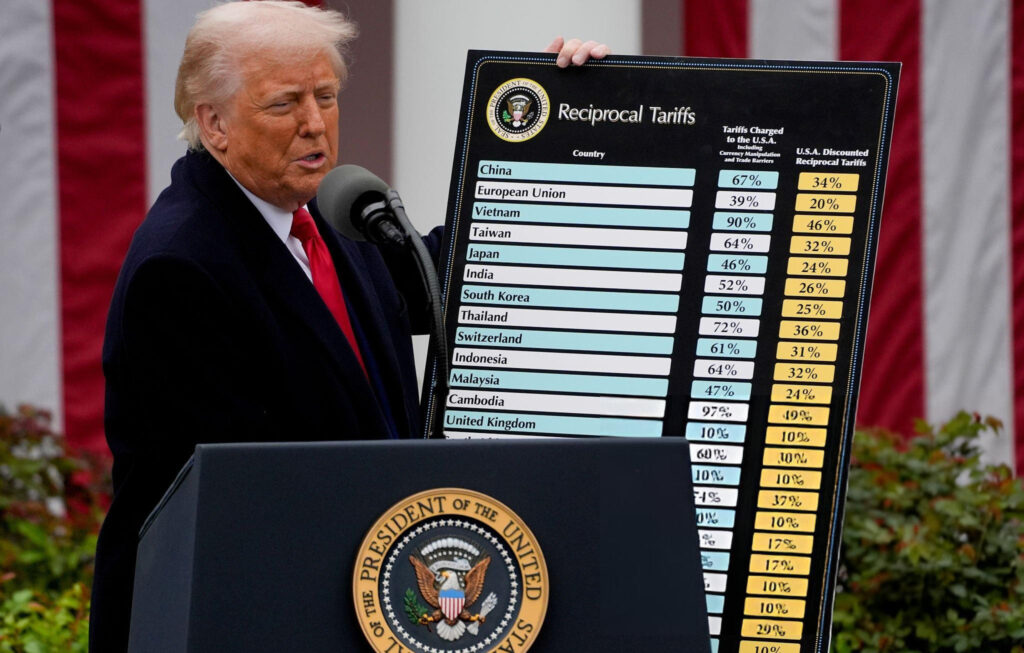
Indian policy makers are in a bind. The given explanation of the tariffs per se the non-alignment of India in the West-Russia conflict is seen as an excuse, rather than a justification. Business people are upset and worried and they doubt the consistency of the U.S. economic venture.
India is reacting at domestic and international levels. It can be seen that the recent “Atmanirbhar Bharat“ (Self-Reliant India) campaign is actually getting some teeth with the new incentives to produce domestically. At the same time, India is voicing up increasingly strong trade agreements with ASEAN, Africa, and even Russia, and the signs of a proto-geopolitical shift can be seen.
4. Germany: The Unjust Punishment of Efficiency
They (Europe–and the Germans (especially)) are still nibbling another rowel with sugar. Automobiles, precision machinery, and green tech in Berlin are subject to up to 20 percent tariffs, an economic hit it does not interpret as an appreciation of the position Germany plays on the world stage.
Decades of preaching of Germany about fiscal conservatism, techno-excellence and export-based development. This model is questioned by the tariffs imposed and viewed by many Germans as their way of being punished by being simply too successful. One of the German leaders made a non-publical remark: We have been strategic partners in the real sense of the term. The trade war has made us its competitors.”
The situation that might make Berlin export more than it needs has made Berlin reconsider its export policies. Alliances with the Gulf in green hydrogen, jumping-across trade deals with the Mercosur bloc, and further integration of the EU economies are again becoming matters of policy.
5. Vietnam: The Target That Played by the Rules
The situation in Vietnam is, probably, the most baffling one. It was marketed as the dream China+1 with great trade regulations after 2018. However, the Trump tariffs on 2025 have caught Hanoi off guard as major sectors such as garments, electronics, and furniture find themselves in the red.
Vietnamese elites are getting angry, lost. We acclimatise, we liberalise, we negotiate,–and we are none the less punished, quoth a diplomatist. The point of it is also very clear: no offense in America First can be halted by loyalty or cooperation.
Vietnam is rapidly becoming less dependent now. The EU-Vietnam Free Trade Agreement (EVFTA) is under rejuvenation, and the Vietnamese are checking out markets in the Middle East, India, and South Korea. The lesson: Even Plan Is Courting Vengeance.
6. Canada: The Disrespected Neighbor
The interaction between the two countries is very much akin to a family one, with some smothering moments and some awkward moments. These new tariffs on aluminum, dairy and lumber are akin to an attack on families. There are ill feelings between Vancouver and Ottawa.
Canadians remember the tariff war of 2018, and they were expecting USMCA would usher in peace. Instead, they currently have to contend with the echo of that disruption. In the editorials, there is some threat to survival over crossborder trust. However, it seems that trade protection was not well received.
Canada is pursuing many initiatives across various layers: on the one hand, it is pressing the case of the tariffs in the WTO; on the other hand, it is considering expanding economic relations with the United Kingdom, Indo-Pacific members, and even South American countries with the Pacific Alliance.
7. South Korea: Friend-Zoned in Trade
South Korea is a long time ally of the U.S., in every aspect, militarily, diplomatically and economically. Even in Seoul, it has not even been spared. The new tariffs on vehicles, semiconductors, and battery parts have come as a blow to conglomerates like Hyundai, LG, and Samsung.
The feeling of implied loyalty is experienced in Seoul. There is a whole school of policymakers who feel that American trade policy is transactional diplomacy rather than partnership.
South Korea is balancing itself out. It is also speeding up bilateral trade relationships in the Gulf countries, discussing technologically related agreements with India, and investing in R&D centers within its home turf to lessen reliance on American suppliers.
8. Japan: The Quiet Disappointment
Japan is silently furious at the U.S tariffs. Even though Tokyo and Washington were close strategic partners, Prime Minister Shinto is being shot by 20 percent tariffs on its auto and robotics exports. The answer has been a remarkably voluble one within a country that is usually subtle in international relations.
The Japanese companies have started raising doubt on the tradition that the U.S-Japan relationship had always given a sense of insulation trade. Trade ministries are reworking their whole export outlook with more focus on regional markets such as Indonesia, Australia and India.
Also, through its dominance in CPTPP (Comprehensive and Progressive Agreement for Trans-Pacific Partnership), Japan is furthering an alternative economic space in which claims of consistency are more dominant as compared to political jolt.
9. Brazil: Agriculture in the Crosshairs
In the case of Brazil, the tariffs imposed by Trump have sliced through the heart of the Brazilian export economy. One of the main sources of beef, ethanol, and sugar, the pillars of the Brazilian agro-export model, fell into the trap of tariff barriers. This not only has an impact on the national GDP but also on the rural economy where it is commonplace to have political victories and losses.
The Brazilian farmers believe they are being punished over American domestic political interests. Given that China is also facing its own tariff tensions, Brazil is turning in earnest towards the east.
The government under the leadership of President Lula is defining a multi-continent commerce policy that specifically takes into account China, the Gulf, and agricultural corridors in Africa. At the domestic front subsidies and stimulus checks are being discussed to smooth things out.
More Read

10. Taiwan: A Strategic Asset Squeezed
The Taiwanese are highly uncut. Not only it is a trade partner, but it is also a backbone of the global semiconductor chain. However, chips and the other forms of technology-based tariffs imposed by the U.S are damaging Taiwanese giants such as TSMC and MediaTek.
The city of Taipei is in an uproar. The alignment to counter China using tactics used by the U.S. have been met with high expectations, yet the tariff measures appear to have the opposite goal that was promised.
Taiwan is ruled by low key emergencies. It is ramping up the technology importation with Japan and India, and moving foundries beyond the U.S., and launching a new discussion with EU states that want to rid themselves of dependence on China or America exclusively.
Trust is the True Currency
This new round of tariffs is not just a rearrangement of the cards of the economy. It is a mental discontinuity in how the world views the concept of American leadership in trade. On the one hand, there are adversaries who feel emboldened and on the other, suspicion between allies and guardedness among the neutrals. There is one thing we will come to see in the post-2025 trade world, and that is the true loser may not be GDP but trust.
To most countries, tariffs imposed by Trump have left an economic scar on them. They have left an unanswered question: Just how does international collaboration expect to survive when it is cooperation that is punished?
And, even more to the point: Who is really exempted to become next?
To receive more deeply reported news and daily news on what is happening in the world follow The Vue Times.